Senate Farm Bill Leaves Critical Organic Investments on the Table
Senate Agriculture Committee Chairman John Boozman (R-Ark.) released his Farm Bill discussion draft on June 24, marking the next major step in the long-delayed effort to enact a new Farm Bill.
The proposal contains several provisions that the National Organic Coalition and our partners support. In some areas, it improves on the Farm Bill passed by the House earlier this year. But it still falls far short of what is needed to help organic farms and businesses thrive, strengthen domestic organic production, and protect the integrity of the organic label.
The Bottom Line
The Senate draft makes modest progress for organic by increasing the authorized funding levels for the National Organic Program, strengthening verification of high-risk organic imports, and creating a responsible process for considering risk-based approaches to organic oversight.
At the same time, it leaves out several of the investments the organic sector needs most. The bill does not provide meaningful relief from rising certification costs, increase mandatory funding for organic research, improve organic dairy data collection, or make the investments needed to help farmers transition to organic production and expand domestic organic markets.
Beyond its shortcomings for organic, the draft also fails to address the deep cuts to the Supplemental Nutrition Assistance Program enacted in 2025—cuts that will reduce food assistance for millions of people, shift substantial costs to states, and weaken markets for farmers and food businesses that receive SNAP dollars.
Because Chairman Boozman has released the legislation as a discussion draft, it may still change. This is an important moment for organic advocates to speak up.
What Happens Next and Why Advocacy Matters Now
The timing and path forward for the bill remain uncertain. A successful Farm Bill will require bipartisan cooperation, both to move through the Senate Agriculture Committee and to secure the support needed for passage by the full Senate. Major disagreements over the Supplemental Nutrition Assistance Program and other issues could make it difficult for the legislation to advance.
That uncertainty does not make advocacy less important. The draft establishes the starting point for the next stage of Senate negotiations, and decisions made in the coming weeks could determine which provisions are added, removed, or strengthened.
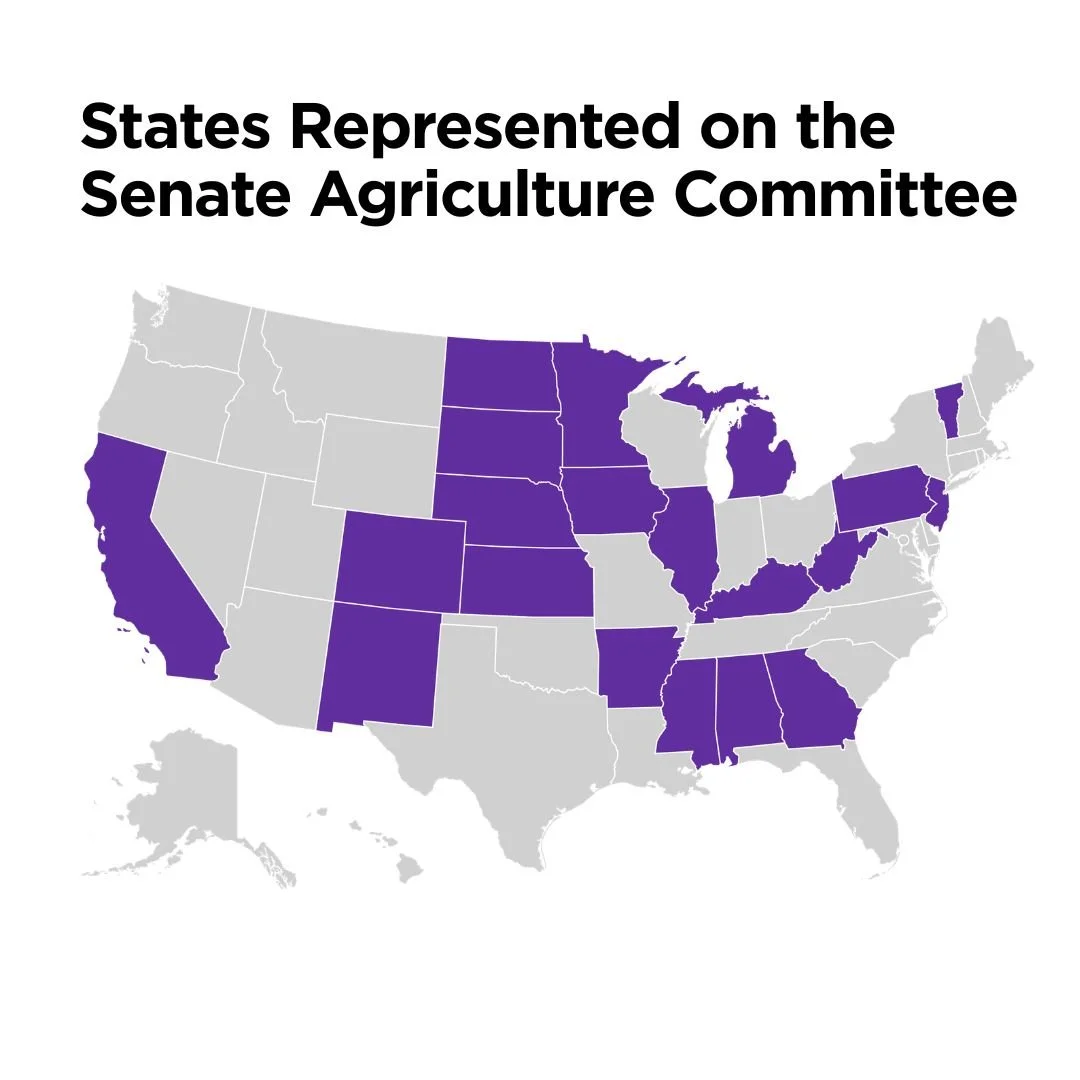
Is your Senator on the Senate Ag Committee? If so, it’s even more important for you to contact your Senator today.
Senators need to hear that a final Farm Bill must do more than preserve existing organic programs. It must address rising certification costs, invest in organic research, support farmers transitioning to organic production, strengthen domestic organic markets, provide equitable access to conservation programs, and ensure that USDA has the capacity to serve farmers and protect organic integrity.
Take Action
Organic advocates should contact members of the Senate Agriculture Committee from both parties and urge them to strengthen the organic provisions as negotiations move forward.
You can:
Contact your senators’ agriculture staff directly to explain which issues matter most to your farm, business, organization, or community.
Ask NOC for help identifying the appropriate Washington-based staff member for senators serving on the Agriculture Committee.
Share and amplify NOC’s Farm Bill action alert.
The Senate discussion draft is not the final word. Engagement now can help determine whether the final Farm Bill merely maintains the status quo or makes the investments necessary to build a stronger and more resilient organic sector.
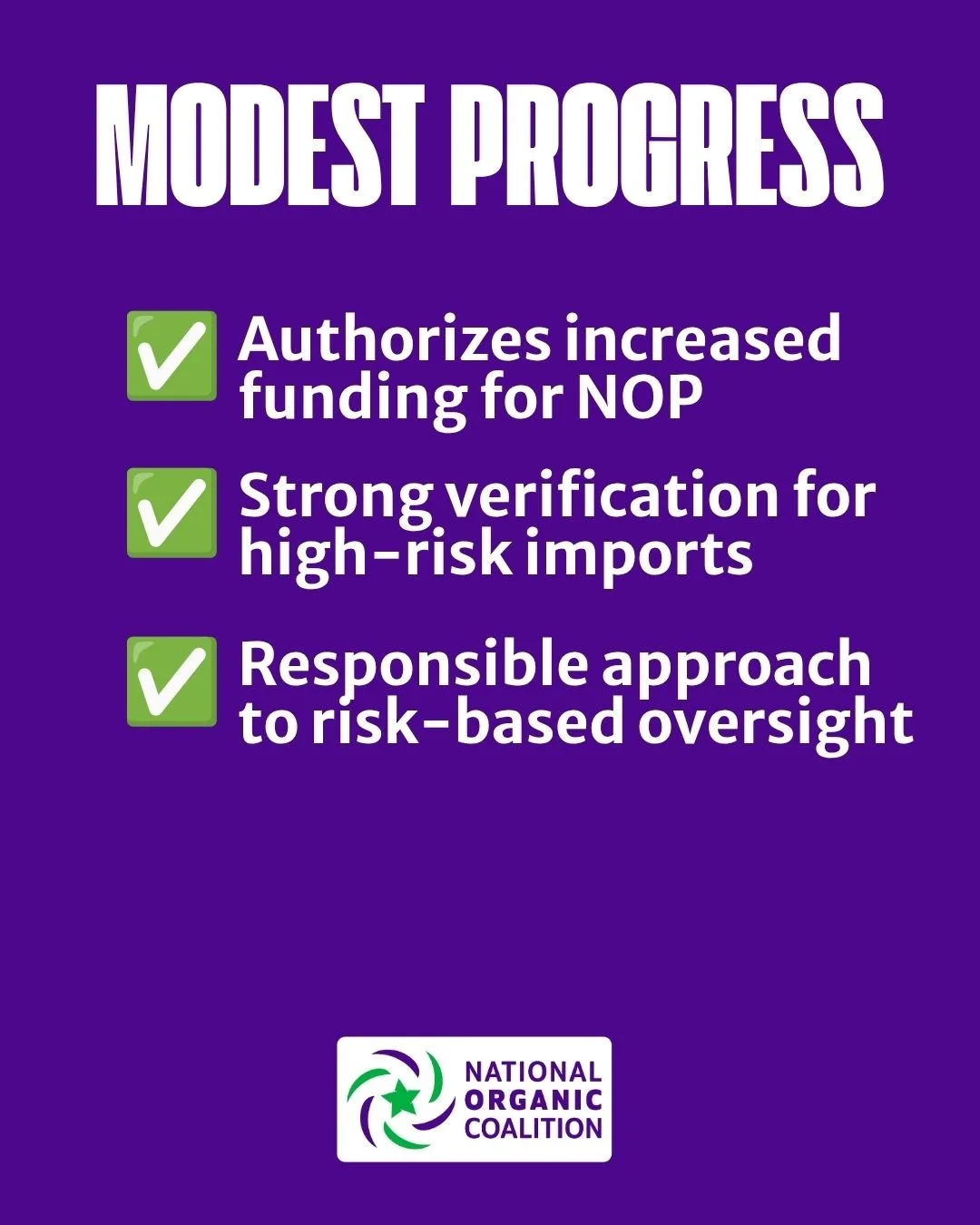
Senate Draft Includes: MODEST PROGRESS FOR ORGANIC
In several areas, the Senate proposal improves on the House bill or incorporates bipartisan provisions supported by NOC.
Increased authorization and outreach capacity for the National Organic Program
The legislation authorizes increased funding for the National Organic Program, beginning at $26 million in fiscal year 2027 and rising in steps to $34 million in fiscal year 2031. This graduated increase improves on the House approach, which would have held the NOP authorization flat.
Both chambers’ proposals authorize USDA to provide technical assistance, education, and outreach to organic farmers. The Senate version goes further, however, by allowing the Secretary of Agriculture to enter into cooperative agreements with nonprofit organizations to provide regionally specific training, education, and outreach—a provision NOC advocated for.
NOC is pleased that the bill recognizes both the need for additional NOP resources and the value of partnering with experienced nonprofit organizations to reach organic farmers in different regions. However, an authorization does not guarantee the level of NOP funding that will be provided each year. Congress must still appropriate these resources annually through the appropriations process. The draft also provides no dedicated funding for the new cooperative agreements.
Stronger verification of high-risk organic imports
The bill incorporates provisions from the Organic Imports Verification Act. These provisions would require USDA to conduct annual residue testing of covered organic feed imports, report on the results, and take corrective action when prohibited substances are detected at impermissible levels.
This is an important step toward strengthening organic integrity and ensuring that domestic organic producers compete on a level playing field.
A responsible approach to risk-based oversight
The Senate bill includes a revised version of the Risk-Based Oversight for Organic Integrity Act that NOC supports.
Rather than immediately changing inspection requirements, the legislation would direct USDA to study whether risk-based or multi-tiered approaches to organic oversight are appropriate. USDA would be required to consult with the National Organic Standards Board, certifiers, organic farms and businesses, organic consumers, and other affected groups before moving forward.
The study would consider whether virtual inspections may be appropriate in some years for certain lower-risk domestic operations while maintaining strong oversight and protecting organic integrity. USDA could pursue rulemaking if the study and consultation process demonstrates that changes are warranted.
Support for regionally adapted seeds and breeds
The Senate bill would amend the Agriculture and Food Research Initiative—USDA’s largest competitive agricultural research grant program—to include regionally adapted cultivar and breed development among its research priorities.
This is a useful policy improvement. However, the bill does not include the dedicated funding NOC has sought to ensure that regionally adapted seed and breed development receives meaningful support.
Investments in local and regional food systems
The bill includes language based on the Local Farmers Feeding Our Communities Act, which would build upon the successful Local Food Purchase Assistance program and strengthen markets for small and mid-sized producers.
However, the proposal relies on discretionary funding rather than guaranteed mandatory funding. Its success would therefore depend on Congress providing sufficient resources through future appropriations.
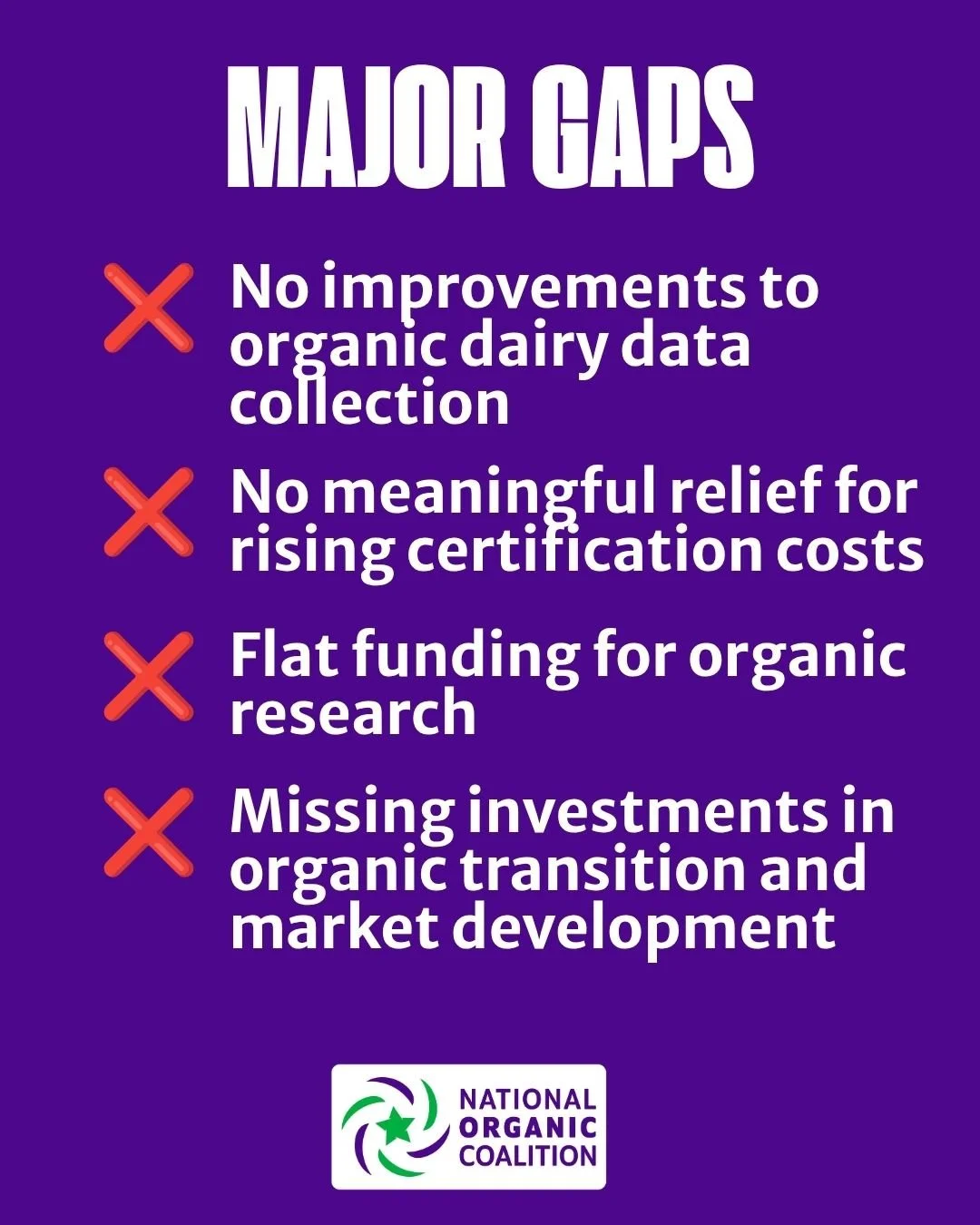
Senate Draft leaves out: Major Gaps Remain for Organic
Despite these improvements, the Senate proposal leaves out several priorities essential to the long-term success of the organic sector.
Major omission: No improvements to organic dairy data collection
Unlike the House Farm Bill, the Senate discussion draft does not appear to include provisions requiring USDA to improve the collection and publication of organic dairy data, including information on milk prices, feed costs, and other production expenses.
This is a major omission. Without reliable and timely data, policymakers and the organic sector cannot fully understand the economics of organic dairy farming or develop effective responses to the serious challenges facing organic dairy producers.
No meaningful relief from rising certification costs
Organic certification costs have risen by more than 85 percent since 2012, but the bill does not increase reimbursement levels under the Organic Certification Cost Share Program.
Reconciliation legislation enacted in 2025 provided $8 million in mandatory funding annually for the program through 2031. With certification expenses continuing to rise, that funding is unlikely to be sufficient over the life of the Farm Bill.
NOC had advocated for additional mandatory funding to ensure that all eligible organic operations can receive meaningful assistance with certification costs. Instead, the Senate bill authorizes supplemental appropriations, leaving Congress to decide each year whether to provide those additional resources. NOC is disappointed that the bill does not guarantee the funding needed to address the program’s anticipated shortfall.
The bill also directs the Government Accountability Office to examine certification costs, but a study does not provide the immediate financial relief organic operations need.
Congress should provide additional mandatory funding, increase reimbursement caps to at least $1,500 per operation per scope, and ensure that the program has sufficient resources to serve all eligible operations.
Flat funding for organic research
The bill maintains mandatory funding for the Organic Agriculture Research and Extension Initiative at $50 million per year.
After years of inflation and repeated delays in passing a new Farm Bill, flat funding represents a real decline in the purchasing power of federal organic research investments. Organic farmers need research that helps them respond to changing weather conditions, pest and disease pressures, soil health challenges, market demands, and other emerging needs.
Unlike the House bill, the Senate draft also does not formally authorize USDA’s Organic Transitions Program. This program supports research that helps farmers adopt organic practices and transition from conventional to organic production, but it has historically relied on annual appropriations without permanent statutory authorization.
The final Senate Farm Bill should include the House provisions formally authorizing the Organic Transitions Program at $20 million annually—well above its current annual funding level of $7.5 million. Providing a clear statutory authorization at this level would demonstrate congressional support for the program and establish a stronger foundation for future appropriations.
The final Senate Farm Bill should include the House provisions formally authorizing the Organic Transitions Program (renamed the Researching the Transition to Organic Program), but authorize a higher level of funding for the program at ($20 million annually) relative to the funding level in the House ($7.5 million annually). Providing a clear statutory authorization at this level would demonstrate congressional support for the program and establish a stronger foundation for future appropriations.
Missing investments in organic transition and market development
The bill does not incorporate the Opportunities in Organic Act or the Domestic Organic Investment Act. These proposals would provide dedicated technical and financial assistance to farmers transitioning to organic production, expand domestic processing and market infrastructure, and help the United States meet growing consumer demand with more domestically produced organic food.
The NOP provisions do authorize USDA to enter into cooperative agreements with nonprofit organizations to provide regionally specific training, education, and outreach. While this authority is a positive step, the bill provides no dedicated funding for these activities and does not offer the direct financial assistance, transition support, or market-development investments included in the Opportunities in Organic Act and the Domestic Organic Investment Act.
Without meaningful funding and a more comprehensive commitment to organic transition and domestic market development, U.S. farmers will remain at a disadvantage and the country will continue to rely heavily on imports even as demand for organic products remains strong.
No response to USDA staffing losses
USDA agencies that organic farmers depend upon—including the National Organic Program, the Natural Resources Conservation Service, and the Farm Service Agency—have experienced significant staffing reductions over the past year.
These losses affect enforcement, technical assistance, conservation program delivery, farmer services, and USDA’s ability to implement new Farm Bill provisions. The Senate bill does not address these workforce challenges.
New authorities and programs will have limited value unless USDA has enough qualified staff to carry them out effectively.
Continued payment inequity in the EQIP Organic Initiative
The Senate discussion draft does not increase the five-year payment limit for producers participating in the EQIP Organic Initiative, leaving the limit at $140,000.
This remains far below both the $450,000 payment limit available through the broader EQIP program and the $200,000 organic limit proposed in the House Farm Bill. Organic farmers should not face a substantially lower payment ceiling when implementing conservation practices through the dedicated organic component of EQIP.
Broader Concerns Affecting Farmers and Communities
The Senate draft avoids two controversial provisions that generated significant concern during consideration of the House bill.
Unlike the House legislation, it does not include language that would override state agricultural production laws such as California’s Proposition 12. It also does not include proposals that would broadly preempt state pesticide warning labels or use restrictions.
However, serious broader concerns remain.
The bill does not repair cuts to nutrition assistance
The proposal does not address the nearly $187 billion reduction in federal nutrition spending, primarily through cuts to the Supplemental Nutrition Assistance Program, enacted in the 2025 budget reconciliation law over the fiscal year 2025–2034 period.
Those changes are expected to reduce or eliminate food assistance for millions of people and shift substantial new benefit and administrative costs to states. The Congressional Budget Office estimated that expanded work requirements alone would reduce SNAP participation by approximately 2.4 million people in an average month.
These cuts also affect farmers and food businesses. SNAP benefits provide purchasing power that flows through farmers markets, food cooperatives, independent grocers, and other local and regional food outlets. Reducing benefits means fewer food dollars reaching the farmers and businesses that serve SNAP participants, weakening markets that are especially important to small and mid-sized producers.
The failure to address the SNAP cost shifts also remains a major obstacle to securing the bipartisan support traditionally needed to pass a Farm Bill.
The Senate Can—and Must—Do Better
The Senate discussion draft contains several useful organic provisions, but it remains far from the Farm Bill organic farmers and businesses need.
As negotiations continue, NOC is working with members of both parties to secure meaningful investments in certification cost assistance, research, organic transition, domestic market development, conservation, USDA staffing, and organic integrity.
Organic advocates have an important role to play in that effort. Contact your senators, share NOC’s action alert, and let policymakers know what a stronger Farm Bill would mean for your farm, business, organization, and community.